
Why Return-To-Office Mandates Are An Accessibility Issue
The push back to the office is leaving workers with disabilities behind.

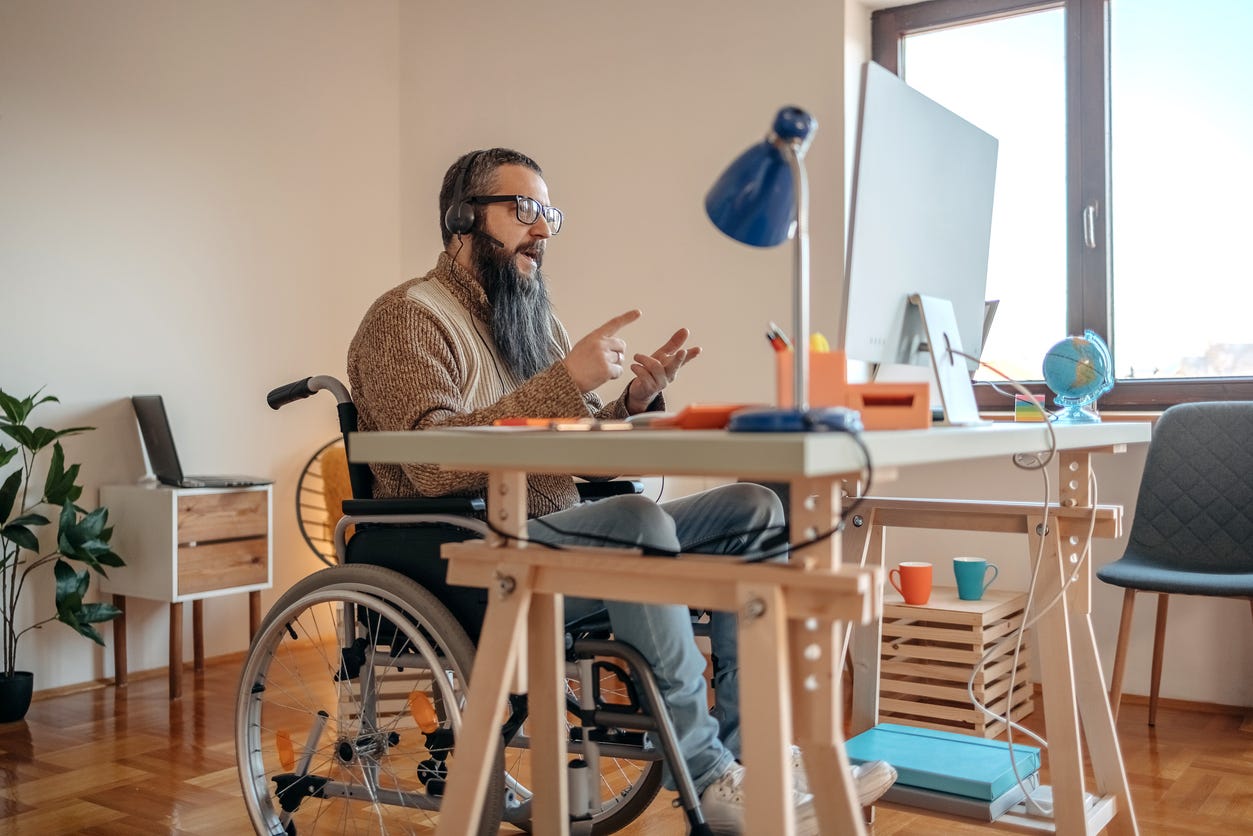
Barbara Whittman, a software engineer from Fulsome, Pennsylvania who has a congenital mobility disability that requires her to use a wheelchair, once worked for a small technology company.
For the first three years of the job, she was able to navigate through the company’s physical office without any issues. But that changed when her employer decided to move their headquarters to a new building. The company’s new offices were on the second floor, and the building had no elevator. This forced Barbara to lift her body up the stairs every day. Almost immediately after, she began looking for a new job.
Barbara’s experiences illustrate the fact that physical offices are fraught with accessibility barriers. Some companies may have tried to make their office spaces accessible, but renovations or retrofits may have caused new barriers to emerge, while other office buildings, especially older ones, were erected without accessibility being considered at all.
While employees with disabilities continue to face barriers related to inaccessible workspaces, companies have increasingly been summoning their workers back to the office in return-to-office (RTO) mandates. In a previous post, I addressed the problems associated with RTO mandates, which, as I mentioned, are more about control than around productivity. But, in addition to its issues, RTO mandates create a major accessibility problem as well.
“One of the biggest mistakes employers make with RTO mandates is treating remote work as a convenience issue,” says Grant Harris, founder of GTH Consulting, a disability-owned business consultancy in Lexington, Virginia. “For many neurodivergent workers, it has functioned as an accessibility layer.”
Remote work changed what accessibility looks like.
When working remotely became all the rage during the COVID-19 pandemic, it wasn’t just a convenience. It meant people with disabilities were able to customize their working environments to suit their needs. They had control over their physical space, not to mention remote work meant more flexible working arrangements. Workers, especially those with chronic disabilities, were able to manage their schedules around flare-ups.
Avril Hertneky, a writer from Ohio who is Deaf, worked remotely as a contractor with Rover, which is a digital platform that connects pet owners with service providers such as pet sitters and dog walkers. Since working from home, Avril was able to customize how she worked to suit her needs, including prioritizing written communication, visual alerts, captioned platforms and flexible scheduling.
RTO mandates re-introduced barriers back into the workplace.
Since working remotely meant no sensory overload, rigid scheduling or constant interruptions, it’s certainly no surprise that employers essentially re-introduced those accessibility barriers back into the workplace with their RTO mandates.
“When employers impose broad RTO mandates without examining how work actually gets done, they often reintroduce barriers that remote or hybrid structures had quietly removed,” Harris says.
He adds that it “can mean lower focus, higher fatigue, more disclosure pressure, more difficulty sustaining performance, and increased attrition risk among neurodivergent employees who were succeeding under different conditions.”
The answer is greater flexibility.
Nathan Putsey, Talent Acquisition Manager with JobLeads, an online job search platform, pinpoints hybrid work as a middle ground, adding that “for employers serious about employee well-being, I advise to really audit which in-office days are crucial and which are required just for the sake of it.”
But Harris frames it less as a hybrid approach and more as universal design. “A stronger middle ground is universal design,” he says. “Build roles, communication norms, and workspace expectations with enough flexibility that fewer people need exceptions just to do their jobs well.”
One recommendation for a truly accessible hybrid approach might be to have an office space which employees can use if they wish to do so, but not as a requirement.
After all, this approach works for Charlotte Bachelor, a marketing and communications professional from Detroit, Michigan who has ADHD and Autism Spectrum Disorder. Bachelor appreciates the flexibility of working from home. But, she also values opportunities to go into the office, especially when she has a big project and needs to use her whiteboard or other office resources, or wants to run things by her boss in-person.
Therefore, if employers really want to be accessible, what’s important is not summoning employees back to the office, but giving them the flexibility to choose where and how they work.
Disclaimer: this article contains several excerpts that will appear in my upcoming book